Black Mold Removal
Containment first removal of black mold on walls, ceilings, and behind drywall, with HEPA filtration and antimicrobial treatment so the spores do not spread through the rest of the house.
Learn more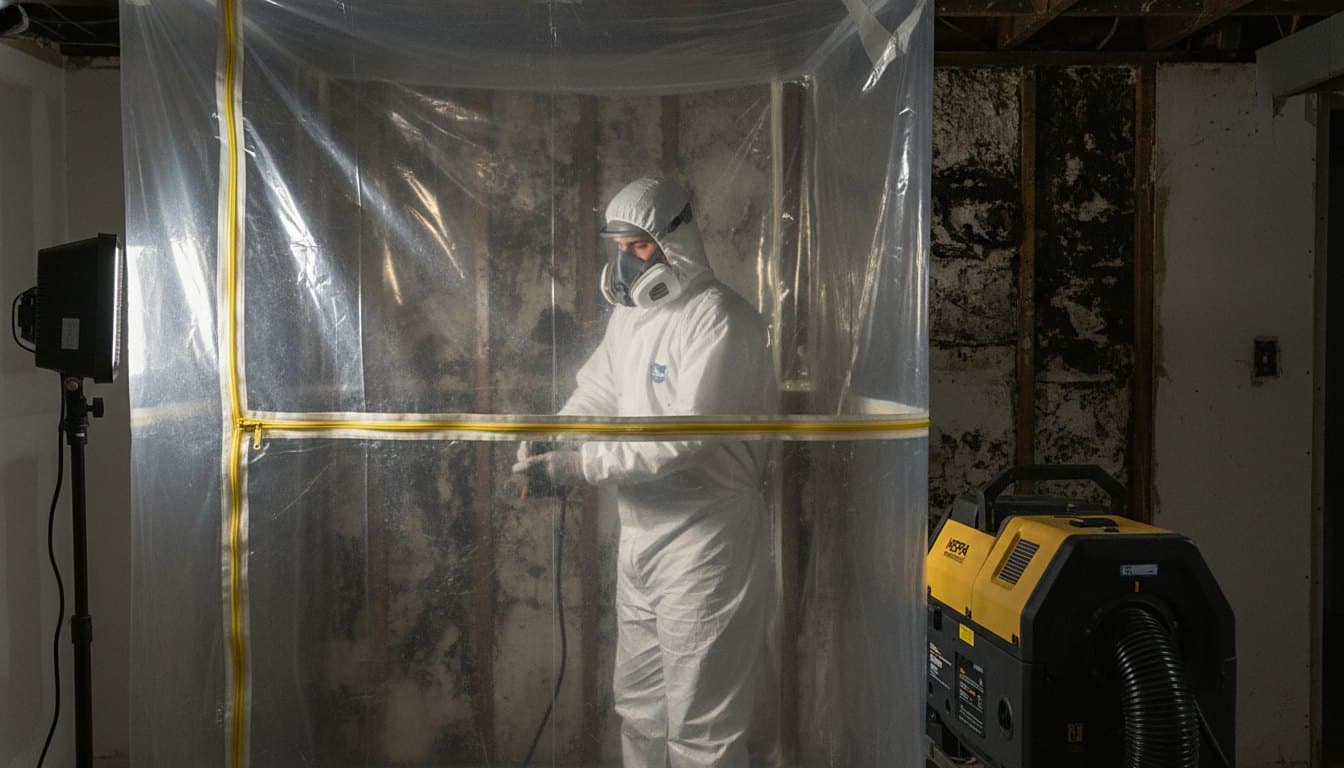
Smell must in the basement or see black spots on a ceiling? Our Royal Oak mold remediation crew finds the source, contains it, and dries your home clean.
Royal Oak mold remediation starts the moment you smell something musty or spot dark patches on a wall, and we handle it from the first call. Our homes here are old. Most were built in the 1950s, sitting over full basements that take on water every spring melt. Damp gets in, mold follows, and the worry sets in fast. We answer the phone, listen to what you are seeing, and get a crew out to look. The sooner we see it, the smaller the problem usually is.
We get it. You are scared for your family's health, worried about the house, and unsure who to trust with it. That fear is fair. Black spots on a ceiling or a heavy smell in the basement are real signals, not things you should wait out. But here is the part that helps: mold is a known problem with a known fix, and we know it cold. We have walked into hundreds of basements, attics, and crawl spaces that smelled just like yours, and we left them clean and dry. And once an attic is clean and dry, keeping it that way is an attic insulation job; the Rochester Hills crew we send people to seals the air leaks that fed the moisture in the first place.
When you call, we listen first, then we come look. We track down the source of the moisture, map how far the mold has spread, and tell you plainly what the job needs to be done right. We do not pad the scope. We do not use scare talk to push you. You get a clear plan and a free quote, so you know what is coming before any work starts and before you spend a dime.
From there, we take over the hard part. We seal off the work area so spores cannot drift into clean rooms. We run HEPA air scrubbers, handle the mold removal at the source, dry the space down to a safe moisture level, and verify the air is clean before we pack up. You get your home back, dry and healthy and quiet again. That is the whole point of what we do. Over in Macomb County, our mold remediation in Warren crew handles that side.
Containment first removal of black mold on walls, ceilings, and behind drywall, with HEPA filtration and antimicrobial treatment so the spores do not spread through the rest of the house.
Learn moreA visual inspection plus air and surface sampling to confirm whether mold is there, name the species, and scope the real job before anyone tears out a wall.
Learn moreRemoval of mold on foundation walls, joists, and stored belongings, then we trace and correct the moisture source so it does not bloom back after we leave.
Learn moreTreatment of dark growth on roof sheathing and rafters from roof leaks, blocked soffit vents, and bath fans dumping into the attic, with the ventilation fixed at the same time.
Learn moreTight access remediation of mold on subfloor framing and a damp crawl space, usually paired with a vapor barrier and dehumidification to keep the underside of the house dry.
Learn moreEmergency drying and mold remediation after a flood, a burst pipe, or a sump failure, with structural drying that beats the 48 hour mold window and the loss documented for your home insurance claim.
Learn moreNot every mold job is done the same way, and the difference shows up months later. A quick wipe with bleach hides the stain for a few weeks, then the mold comes back through the paint. A real remediation removes the mold, fixes the water that fed it, and proves the air is clean. That is the standard we hold our Royal Oak mold remediation work to, every time.
The first thing that sets a quality job apart is containment. Mold spreads by spores, and spores ride the air. The moment you start scrubbing or cutting drywall, you launch millions of them into the rest of the house. So before we touch the mold, we seal the work zone with plastic sheeting and put it under negative air pressure. That means the air flows into the contained space, not out of it. Your kitchen and bedrooms stay clean while we work. This one step is the difference between fixing a problem and spreading it.
Next comes the air itself. We run HEPA air scrubbers the whole time we work. These pull the loose spores out of the air and trap them in a filter fine enough to catch particles you cannot see. We also HEPA vacuum the surfaces, not just wipe them. Then we treat what is left with an antimicrobial to knock down any spores that hang on. Bleach is not part of this. Bleach mostly bleaches the color out of mold on porous surfaces while leaving the roots behind, which is why the stain comes back.
Then we deal with the real cause, which is almost always water. This is where most cheap jobs fail. Mold does not grow without moisture, so if the moisture stays, the mold returns no matter how well you cleaned. We dry the space with air movers and dehumidifiers, and we do not guess when it is dry. We dry to a moisture target, measured with a meter against a known dry reading for that material. Wood, drywall, and concrete each hold water differently, so we read each one. When the numbers hit the target, the space is dry. Not before. And when a burst pipe or a flood has done wider harm than mold, full water damage restoration is the job that comes before ours.
Here is the Royal Oak failure mode we see most. The classic 1950s house sits over a full basement with an old foundation and a single sump pit. Spring snow melt and heavy rain push water against the walls and up through the slab. The basement gets damp, the humidity climbs, and mold blooms on the foundation walls, the joists, and any boxes stored down there. A homeowner cleans the visible patch, but the source keeps loading the room with water. Within a season, it is back. We break that cycle by correcting the moisture, not just the stain, so the basement stays dry through the next melt. If the water has already chewed through drywall or flooring, honest water damage repair puts the space back together once the source is fixed.
The last step is the one most people skip, and it is the one that matters most. Clearance. After the mold remediation is done and the space is dry, we verify the work. We check that the surfaces are clean, the air reads normal, and the moisture is where it should be. For a serious job, that can mean an independent test by an outside hygienist, so the final sign off does not come only from the company that did the work. Then we hand the home back to you with a clear picture of what we found, what we did, and how to keep it from coming back. Sometimes keeping it from coming back is not our trade at all; a damp dirt crawl space wants crawl space insulation and encapsulation after we clear it, the way the Joliet outfit we compare notes with builds them.
Our crews train to IICRC standards and follow EPA mold guidance, so the steps above are not shortcuts we invented. They are how the work is supposed to be done. When you understand what a proper job looks like, you can tell the difference between someone who will fix this once and someone who will be back next spring. We aim to be the first kind. You smell it, you see it, you call. We make it clean, dry, and done.
A short on-site visit. We look at the job in person and write a fixed quote on paper, not over the phone.
The slow, unglamorous step most shortcuts skip. Done right here so the finish actually holds.
A local crew runs the job in the order that lasts, with the materials named in the quote.
We hand the work back with a final walk-through, so you see exactly what was done and why.
If the mold is right there on the wall, we can often start the cleanup without a test. Testing earns its place when the smell is there but the source is hidden, or when you need proof for a sale. It also tells us the species and how far it has spread, so the removal is scoped to the real problem and not a guess.
The report tells you what a kit never will. It lists the spore count in your air, names the mold species the lab found, and sets your indoor reading against an outdoor baseline taken the same day. It also flags the wet spots we measured. Together that shows whether you have a real problem, where it is, and what the removal needs to cover.
It depends on the size of the home and how many rooms we sample, so we give you a clear quote before any work. The test itself takes an hour or two on site. The lab results usually come back in a few business days. We then walk you through the report so you know exactly what it means and what comes next.
Air testing is the part most homeowners miss. Mold can grow inside a wall, under a floor, or in a duct where you will never see it, yet the spores still drift into the air you breathe. An air sample catches that hidden growth. If your family feels stuffy at home but the walls look clean, the air test is how we find what your eyes cannot.
Mold keeps coming back because cleaning the surface does nothing about the water feeding it. The block is porous, so the roots live deep inside, and the damp from seepage or humidity never left. Wipe it and it returns in a season. We remove the mold and fix the moisture source, so the wall stays clean for good.


